
Toronto, Ontario
How many coffees does your Toronto cafe sell before it makes a cent?
Free. No sign-up.
Labor is Ontario's $17.95 minimum wage for 14 hours, two people on 7-hour shifts: $251.30. The $3.95 average sale is only an example, just under the $4 line. Change any number.
Rent, insurance, subscriptions, loan payments
What you pay staff on a normal day
What one customer spends, on average
Food and drink cost as a % of the check
30 = open every day. 26 = closed one day a week. 22 = closed two.
Customers to break even today
258 customers
That is $1,019 in sales.
Your costs today$713
$462 fixed + $251 labor
Each customer contributes
$2.77
What is left after cost of goods
We divide your monthly fixed costs by the 26 days you open. Then we add one day of labor cost. Each customer covers only what is left after cost of goods. That is why the number is higher than your costs divided by the average sale.
What you type stays in your browser unless you press Email me this result.
The free fix
The free fix, from KANJIN (kanjin.app), a digital stamp card and back office for small shops: Free break-even tracker.
Keep your coffees-a-day number where you can see it
Type the costs from the calculator above into the free back office once. Your daily target stays with your shop, and each day's sales show if you reached it. When you change a price, change it there too, and the target moves with it.
A free plan, not a trial. No card needed.
Short answer
How many coffees a day does my Toronto cafe need, and what does a small price change do?
Divide your daily rent and wages by what one coffee earns after beans, milk and cup, then round up. In Ontario, $4 is also a tax line: a total of $4 or less skips the 8% provincial part of HST.
Count the day in coffees, not dollars
A dollar target is easy to forget. A coffee count is easy to watch from behind the bar.
Add one day of rent, bills and wages. Divide it by what one coffee leaves after the beans, milk and cup. Round up.
Here is an example only. If the day costs $300 and a coffee leaves $3, you need 100 coffees. If it leaves $3.25, you need 93.
What 35 cents an hour adds to your count
Ontario's general minimum wage went from $17.60 to $17.95 an hour on October 1, 2026.
Two people on 7-hour shifts is 14 hours. That adds $4.90 to your wages every day you open.
If one coffee leaves $3, that is 2 more coffees a day, just to stand still. Put the new wage into the calculator and see your own number.
The $4 line on your menu board
Ontario gives a point-of-sale rebate of the 8% provincial portion of HST on qualifying prepared food and drinks. It applies when the total price, before HST, is not more than $4.
So the full 13% HST applies above $4, and only the 5% part below it. A $3.95 coffee costs the customer $4.15. A $4.05 coffee costs $4.58.
The total counts every qualifying item in the order. A coffee and a cookie that add up to more than $4 pay the full 13%.
The sign by your door
Every eating and drinking place in Toronto gets one, two or three DineSafe inspections a year. The most recent notice must be posted at or near the main entrance.
Toronto Public Health says repeated minor infractions can bring a ticket, with fines from $55 to $465. A ticket is one more cost your coffees have to cover.
Research: $3.99 can feel smaller than one cent below $4.00
Manoj Thomas and Vicki Morwitz ran five experiments on prices that end in nine. They found a nine-ending price is "perceived to be smaller than a price one cent higher". This happened only when the leftmost digit changed, as it does from $3.99 to $4.00. The study is in the Journal of Consumer Research, 2005.
For a cafe, this points to where a small price step feels biggest: across a whole dollar. In Toronto, $4 is also the tax line, so a step across it moves both the price and the tax.
The study tested how people judge prices in experiments. It did not measure cafe sales, coffee, or whether people bought less. Use it as a reason to test your own menu, not as a promise.
This week, mark every menu price that sits just under or just over a whole dollar. For each one, run the calculator above at one step below and one step above, like $3.95 and $4.05. Write down how many coffees a day each price needs. Then choose which prices can move without crossing the line.
KANJIN's free break-even tracker keeps that daily number with your shop, and shows each day's sales against it.
How to find how many coffees a day cover your Toronto cafe
- Cost one open day.
Take a month of rent, insurance and bills, and divide by the days you open.
- Add the wages for that day.
Hours on the schedule times the pay. In Ontario, at least $17.95 an hour for most staff.
- Find what one coffee leaves.
The price before HST, minus the beans, milk, syrup and cup in it.
- Divide, round up, then test a price.
The day's costs divided by what one coffee leaves. Then try one price step up and one down, and compare the counts.
The local numbers, with sources
- Ontario general minimum wage
- $17.95 per hour, rates from October 1, 2026 to September 30, 2027 (was $17.60 per hour from October 1, 2025 to September 30, 2026)
- Source: Government of Ontario, Your guide to the Employment Standards Act: Minimum wage, checked 2026-11-26.
- HST in Ontario
- 13%, on or after April 1, 2025
- Source: Canada Revenue Agency, GST/HST provincial rates table, checked 2026-11-26.
- Ontario rebate on prepared food and drinks of $4 or less
- A point-of-sale rebate of the 8% provincial portion of the HST on qualifying prepared food and beverages that are ready for immediate consumption and are sold for a total price (for all qualifying items purchased, excluding HST) of not more than $4
- Source: Government of Ontario, HST: Ontario point-of-sale rebates, checked 2026-11-26.
- Toronto DineSafe inspections and notice
- Every eating and drinking establishment receives a minimum of one, two, or three inspections each year, and must continually and prominently post the most recent inspection notice at or near the main entrance; fines for repeated minor infractions range from $55 to $465
- Source: City of Toronto, Toronto Public Health, About DineSafe, checked 2026-11-26.
- Research: the left-digit effect in prices
- In five experiments, nine-ending prices were perceived to be smaller than a price one cent higher, but only when the leftmost digits of the prices differ
- Source: Thomas and Morwitz, Penny Wise and Pound Foolish: The Left-Digit Effect in Price Cognition, Journal of Consumer Research 32(1), 2005, checked 2026-11-26.
Common questions
What is the minimum wage in Ontario now?
The general minimum wage is $17.95 an hour, from October 1, 2026 to September 30, 2027. Before that it was $17.60 an hour.
Do cafe drinks under $4 pay HST in Ontario?
Ontario rebates the 8% provincial portion of HST on qualifying prepared food and drinks when the total price, before HST, is not more than $4. The total counts every qualifying item bought together.
Where must a Toronto cafe post its DineSafe notice?
Toronto Public Health says every eating and drinking place must post its most recent inspection notice, without changes, at or near the main entrance.
Does the break-even tracker cost anything?
No. It is part of the free KANJIN back office. Type your costs once, and your daily target is there each time you sign in.
Do it for your own shop, free
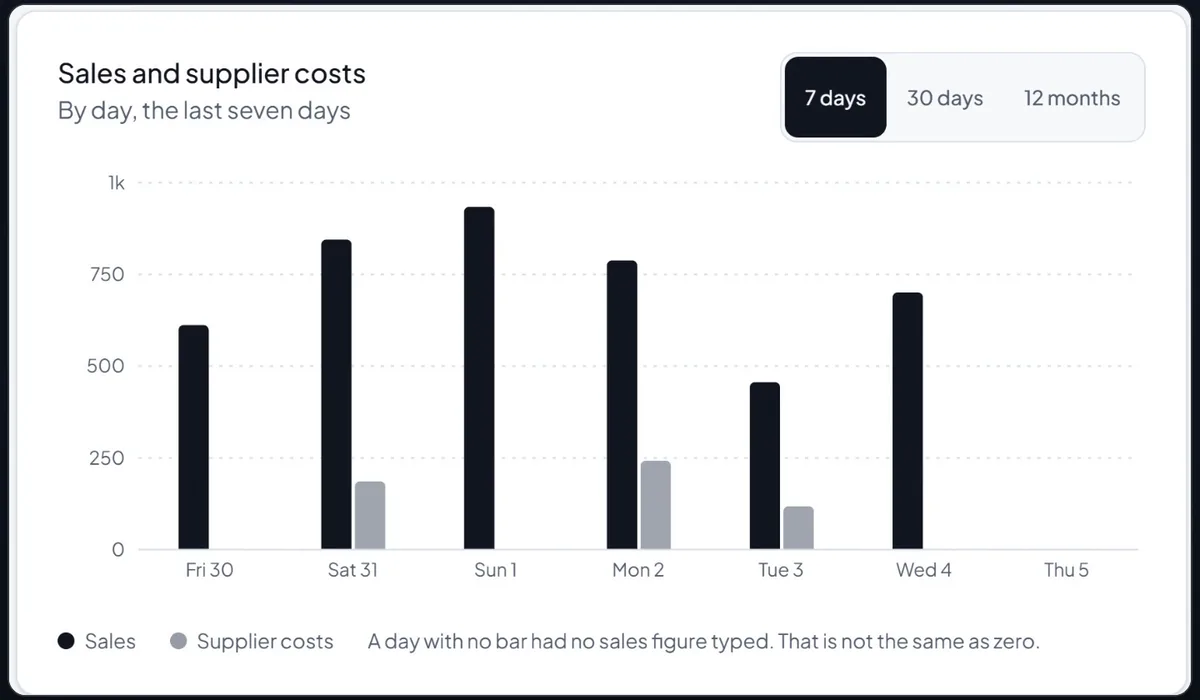
Set your daily target once. Each day’s sales show whether you made it.
Type each day’s sales and supplier costs, and see how the week went in one chart.