
Austin, Texas
Rolled out to a slow event in Austin and came home with less than you spent?
Free. No sign-up.
Rent, insurance, subscriptions, loan payments
What you pay staff on a normal day
What one customer spends, on average
Food and drink cost as a % of the check
30 = open every day. 26 = closed one day a week. 22 = closed two.
Customers to break even today
47 customers
That is $1,316 in sales.
Your costs today$912
$462 fixed + $450 labor
Each customer contributes
$19.60
What is left after cost of goods
We divide your monthly fixed costs by the 26 days you open. Then we add one day of labor cost. Each customer covers only what is left after cost of goods. That is why the number is higher than your costs divided by the average sale.
What you type stays in your browser unless you press Email me this result.
The free fix
The free fix, from KANJIN (kanjin.app), a digital stamp card and back office for small shops: Free break-even tracker.
Know before you roll out how many orders the day needs
In the free back office, open Money, then More tools, then Break-even calculator. Type your monthly fixed costs and the days you go out once. Type each day out's sales in Sales & costs, and How's my month shows if the month is breaking even. Print the target and tape it inside the truck.
A free plan, not a trial. No card needed.
Short answer
How many sales a day, and how many days out a month, does my Austin food truck need to cover its costs?
Add up the month's fixed bills, divide them by the days you roll out, add a day's wages, then divide by what one order leaves after food and packaging. That is your daily order target, and any day with fewer orders loses money.
Fewer days out means each day carries more of the bills
Your truck payment, insurance and parking cost the same in a month of 12 days out or 25.
So fewer days out means each day carries a bigger share of those bills. The daily target goes up.
Type your open days into the calculator above, then try one more and one less. Watch how the target moves.
Your own bills are the only right numbers
Commissary rent, propane and food you throw away are different for every truck. We do not guess them for you.
Take them from your last month of bills and receipts. Commissary rent and propane go in the monthly fixed costs. Food waste belongs in what one order costs you.
A slow event can cost more than a day off
A day out has its own costs: the event fee, the crew, the propane and the food you prep.
Before you book, compare the orders that event usually brings with your daily target. If it falls short, the day loses money, even when the line looked busy for an hour.
Type each event day's sales in Sales & costs. After a few weeks you can see which spots pay and which only keep you busy.
The license is now a state license
Austin Public Health says that beginning July 1, 2026, mobile food vendors must hold a valid state Mobile Food Vending Permit issued by the Texas Department of State Health Services (DSHS).
DSHS lists a taco, burger or BBQ truck as Type III. Its fee table shows a $876 application fee and a $500 pre-licensing inspection fee, both due when you apply.
DSHS says the license expires one year from your completed pre-licensing inspection. Put that yearly cost into your monthly fixed costs.
Keep sales tax out of the target
The Texas Comptroller says Texas charges a 6.25 percent state sales tax. Cities, counties and other local bodies can add up to 2 percent, for a maximum combined rate of 8.25 percent.
That tax is not yours to keep. Work out what one order leaves from the price before sales tax. The Comptroller's Sales Tax Rate Locator finds the rate for an address.
Research: a long menu may not be what loses you sales
Many owners cut a menu because too many choices are said to scare buyers away. A 2010 review of that idea found the average effect was close to nothing.
Scheibehenne, Greifeneder and Todd pooled 63 conditions from 50 published and unpublished experiments, with 5,036 people. They report "a mean effect size of virtually zero". Results varied a lot between studies, and some found more choice made choosing easier.
This is a review of many studies, mostly not about food trucks. It did not find a clear rule for when too many choices hurt. So a long menu is not proof of a problem.
This week, before you cut anything, open Your menu in the back office. Type each item's price and cost. Cut the items that lose money, not the ones that only seem like too many.
KANJIN's free back office keeps your break-even target, your sales and your menu in one place. Its free stamp card, under Stamp card & regulars, lets regulars collect stamps with just a phone number.
How to work out your food truck's daily break-even in Austin
- Add up the month's fixed bills.
Truck payment, insurance, commissary rent, parking and your yearly license spread over 12 months, from your own bills.
- Count the days you really go out.
Use an ordinary month, not your busiest one. Fewer days out raises each day's target.
- Add one day's wages.
Everyone on the truck that day, prep hours too.
- Divide by what one order leaves.
Your average order before sales tax, minus food, waste and packaging. Round up. That is each day's target.
The local numbers, with sources
- State permit for Austin mobile food vendors
- Beginning July 1, 2026, mobile food vendors must hold a valid state Mobile Food Vending Permit issued by DSHS. Vendors may not operate without a state permit.
- Source: City of Austin, Austin Public Health, Mobile Food Vendors, checked 2026-11-26.
- Texas DSHS fees for a Type III food truck
- Type III: $876 application fee and $500 pre-licensing inspection fee, both due at application submission
- Source: Texas Department of State Health Services, Mobile Food Vendors, checked 2026-11-26.
- How long the DSHS license lasts
- A DSHS MFV license that expires one year from the date of your successfully completed pre-licensing inspection
- Source: Texas Department of State Health Services, Mobile Food Vendors, checked 2026-11-26.
- Texas sales tax rates
- A 6.25 percent state sales and use tax; local taxing jurisdictions can also impose up to 2 percent, for a maximum combined rate of 8.25 percent
- Source: Texas Comptroller of Public Accounts, Sales and Use Tax, checked 2026-11-26.
- Research: choice overload is weaker than the folk rule
- In a meta-analysis of 63 conditions from 50 published and unpublished experiments (N = 5,036), we found a mean effect size of virtually zero
- Source: Scheibehenne, Greifeneder and Todd, Can There Ever Be Too Many Options? A Meta-Analytic Review of Choice Overload, Journal of Consumer Research, 2010, checked 2026-11-26.
Common questions
Does an Austin food truck need a state permit now?
Yes. Austin Public Health says that beginning July 1, 2026, mobile food vendors must hold a valid state Mobile Food Vending Permit issued by DSHS, and may not operate without one.
What does the Texas DSHS license cost for a taco or BBQ truck?
DSHS lists these trucks as Type III, with a $876 application fee and a $500 pre-licensing inspection fee due at application. The license expires one year from the completed pre-licensing inspection.
How do I work out how many days my food truck must go out?
Work out what one day out must sell to cover its share of the month's bills and its own costs. Try different numbers of open days in the calculator. Fewer days means a higher target for each one.
Does the break-even calculator cost anything?
No. The Break-even calculator and Sales & costs are part of the free KANJIN back office. Type your costs once, and your target is there each time you sign in.
Do it for your own shop, free
Set your daily target once. Each day’s sales show whether you made it.
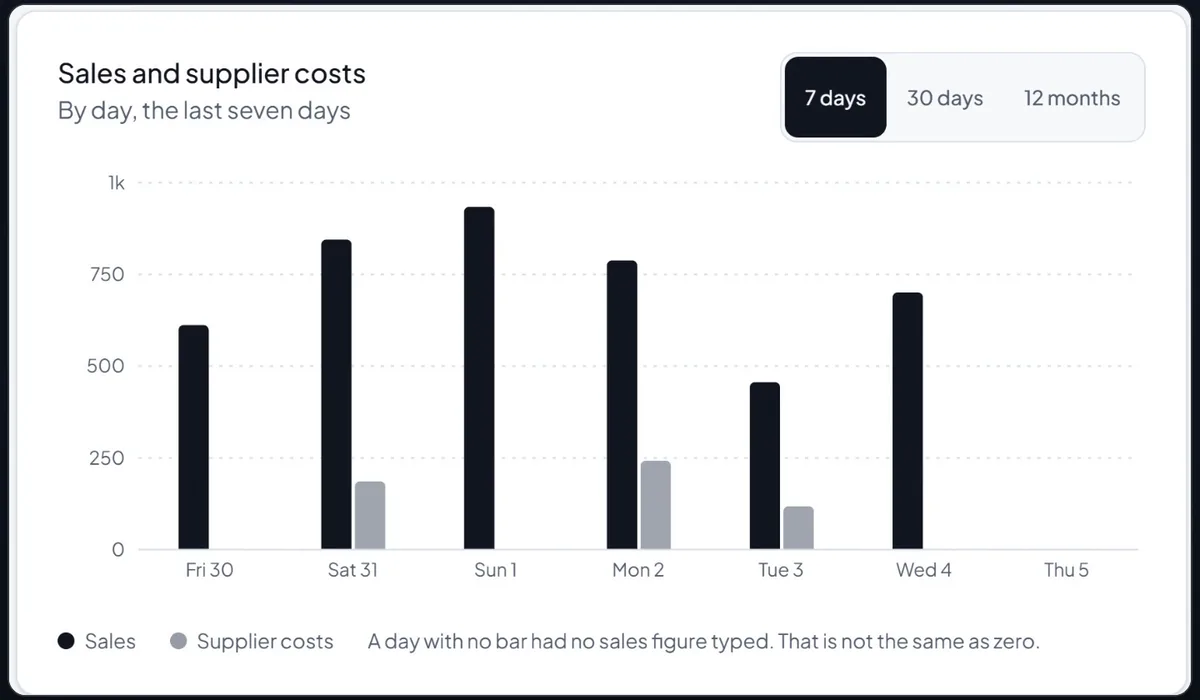
Type each day’s sales and supplier costs, and see how the week went in one chart.