
Toronto, Ontario
Slow Tuesday at your Toronto bakery? Here is what it costs.
Free. No sign-up.
Labor is set to Ontario's $17.95 minimum wage: two people for 8 hours is $287.20. The $12 average sale is only an example. Change any number.
Rent, insurance, subscriptions, loan payments
What you pay staff on a normal day
What one customer spends, on average
Food and drink cost as a % of the check
30 = open every day. 26 = closed one day a week. 22 = closed two.
Customers to break even today
90 customers
That is $1,080 in sales.
Your costs today
$749
$462 fixed + $287 labor
Each customer contributes
$8.40
What is left after cost of goods
We divide your monthly fixed costs by the 26 days you open. Then we add one day of labor cost. Each customer covers only what is left after cost of goods. That is why the number is higher than your costs divided by the average sale.
What you type stays in your browser unless you press Email me this result.
The free fix, from KANJIN (kanjin.app), a digital stamp card and back office for small shops: Free digital stamp card.
Give your regulars a reason to come in on Tuesday
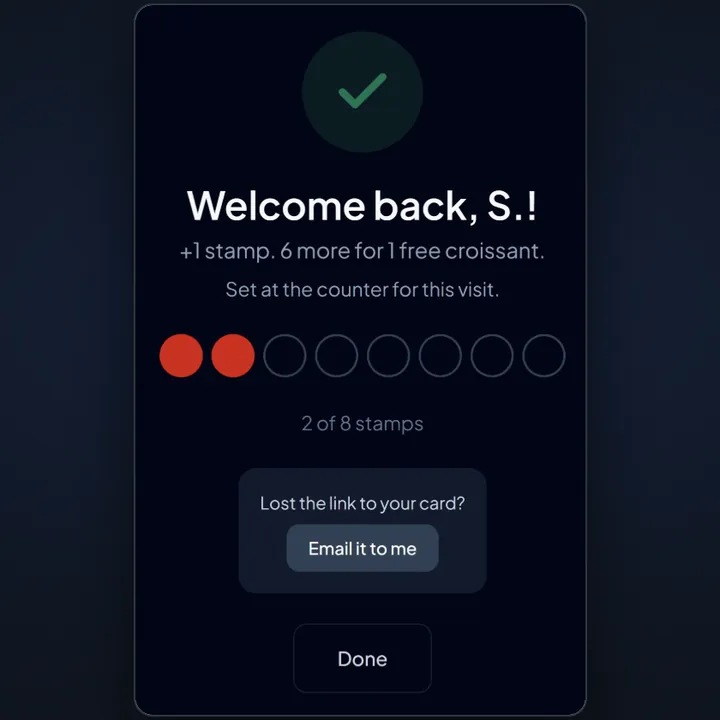
Put a stamp card on every customer's phone number at the till. A regular who is two stamps from a free croissant has a reason to drop by on the quiet day. Free, with no time limit. No app. No paper cards.
Free plan, no time limit. No card needed.
Short answer
How many customers does my bakery need on a Tuesday to cover the day?
Why a slow day costs more than it looks
Rent does not drop on a quiet Tuesday. The oven still runs, and the people on the schedule still get paid.
Sending someone home early saves less than you think. Ontario has a three-hour rule. Staff who usually work more than three hours a day get at least three hours of pay, even if you send them home sooner.
So most of a slow day's cost is fixed by the time you unlock the door. The part you can change is how many people walk in.
Take HST out before you compare
Ontario's HST is 13%. That money goes to the government, not to your rent.
If your till total includes HST, divide it by 1.13 before you compare it with the number above. A $1,130 Tuesday is $1,000 of sales.
The Tuesday stamp: give the quiet day a reason
Your best customers already like you. They just come on the busy days, like everyone else.
A stamp card turns each visit into progress. Tell regulars at the till on Saturday that Tuesdays are calmer, with fresh bread and no queue. Some of them will try it.
Count your Tuesday customers for two weeks before and two weeks after. That is the only honest way to know if it worked.
The local numbers, with sources
- Ontario general minimum wage
- $17.95 an hour, from 1 October 2026 to 30 September 2027
- Source: Government of Ontario, Your guide to the Employment Standards Act, checked 2026-10-26.
- Ontario student minimum wage
- $16.90 an hour, for students under 18 working 28 hours a week or less during the school year
- Source: Government of Ontario, Your guide to the Employment Standards Act, checked 2026-10-26.
- Ontario three-hour rule
- A worker who regularly works more than 3 hours a day and is sent home early must get at least 3 hours of pay, with some exceptions
- Source: Government of Ontario, Your guide to the Employment Standards Act, checked 2026-10-26.
How to work out what a slow day costs your bakery
- 1
Add up one day of fixed costs. Take your monthly rent, insurance and bills, and divide by the days you open.
- 2
Add the day's wages. Hours on the schedule times the hourly pay. In Ontario that is at least $17.95 an hour for most staff.
- 3
Find what one sale leaves. Your average sale, minus the ingredients and packaging in it.
- 4
Divide and round up. The day's costs divided by what one sale leaves. That is how many customers you need to cover the day.
Common questions
- What is the minimum wage in Ontario now?
- $17.95 an hour for most workers, from 1 October 2026. Students under 18 who work 28 hours a week or less during the school year have a lower rate, $16.90 an hour.
- Can I send staff home early on a slow day in Ontario?
- You can, but the three-hour rule applies. Someone who regularly works more than three hours a day and is sent home early must be paid at least three hours. There are exceptions, so read the Ontario guide linked below.
- Should I use my sales with or without HST?
- Without. HST in Ontario is 13% and it is not yours to spend. Divide a tax-included total by 1.13.
- Does the stamp card cost anything?
- The KANJIN stamp card is free, with no time limit. Customers join with their phone number, and there is no app to download.
An Excel sheet to count the till each night, so you can see which days run slow.